Your daughter isn't more likely to tear her ACL because she's a girl. She's more likely to tear it because she's a girl at a specific moment in her development — and nobody told you that moment was coming, or that it was trainable.
Female adolescent athletes sustain ACL injuries at four to six times the rate of male athletes in comparable sports [5]. For decades, the explanation defaulted to anatomy: narrower notch, wider pelvis, different hormones. Partly true, as far as it goes. But that framing implies it's fixed — structural, inevitable, not your problem to solve. The more important truth is that the primary driver of this gap is neuromuscular, not anatomical. And neuromuscular is modifiable.
The risk window opens around age 12. It peaks near 16. And the research on what to do about it is unusually good.
Why Boys and Girls Diverge at Puberty
During puberty, boys typically experience parallel gains in muscle mass, strength, and — this is the part most people miss — neuromuscular coordination. Researchers call it the "neuromuscular spurt." It's not just that boys get bigger. Their nervous systems get better at recruiting muscle, controlling force, and managing the demands of high-speed, multi-directional movement.
Girls' skeletal growth during puberty is not matched by a comparable gain in strength and neuromuscular control. The result is a body that has gotten taller and heavier without proportionally upgrading the control system that protects it.
This divergence produces four specific movement patterns that raise ACL risk, all of which emerge during adolescence and all of which are modifiable with the right training:
Dynamic knee valgus — the knee collapsing inward during landing, cutting, or pivoting. This is the primary mechanical risk factor for ACL injury. It's driven largely by weakness in the hip abductors and hip external rotators — muscles that the neuromuscular spurt strengthens in boys but not in girls. You can see this pattern with the naked eye: watch her land from a small jump. If her knees collapse inward toward each other while her feet stay apart, that's the movement signature the training in this article is designed to change — and a useful benchmark for whether training is producing results over time.
Quadriceps dominance — during deceleration and landing, females more often rely on the quadriceps relative to the hamstrings. This matters mechanically: hamstring co-contraction reduces anterior shear force at the tibia, which is one of the primary loads on the ACL. A landing pattern dominated by the quadriceps with insufficient hamstring contribution shifts more of that load directly onto the ligament.
Reduced knee flexion on landing — landing with a straighter knee dramatically increases ACL load. Research confirms that neuromuscular training produces measurable increases in knee flexion angle during jump-landing tasks in young female athletes [7] — shifting the knee toward a safer, more absorbed loading position.
Lateral trunk displacement — when the trunk shifts sideways during single-leg tasks, the forces at the knee increase sharply. Core stability strongly predicts knee injury risk in female athletes. The predictive relationship is substantially weaker in males — which tells you something important about where the female-specific vulnerability lies [see Pillar 4].
None of these are permanent. All of them can be trained. The window in which they're most trainable is early adolescence.
The Boardercross Frame
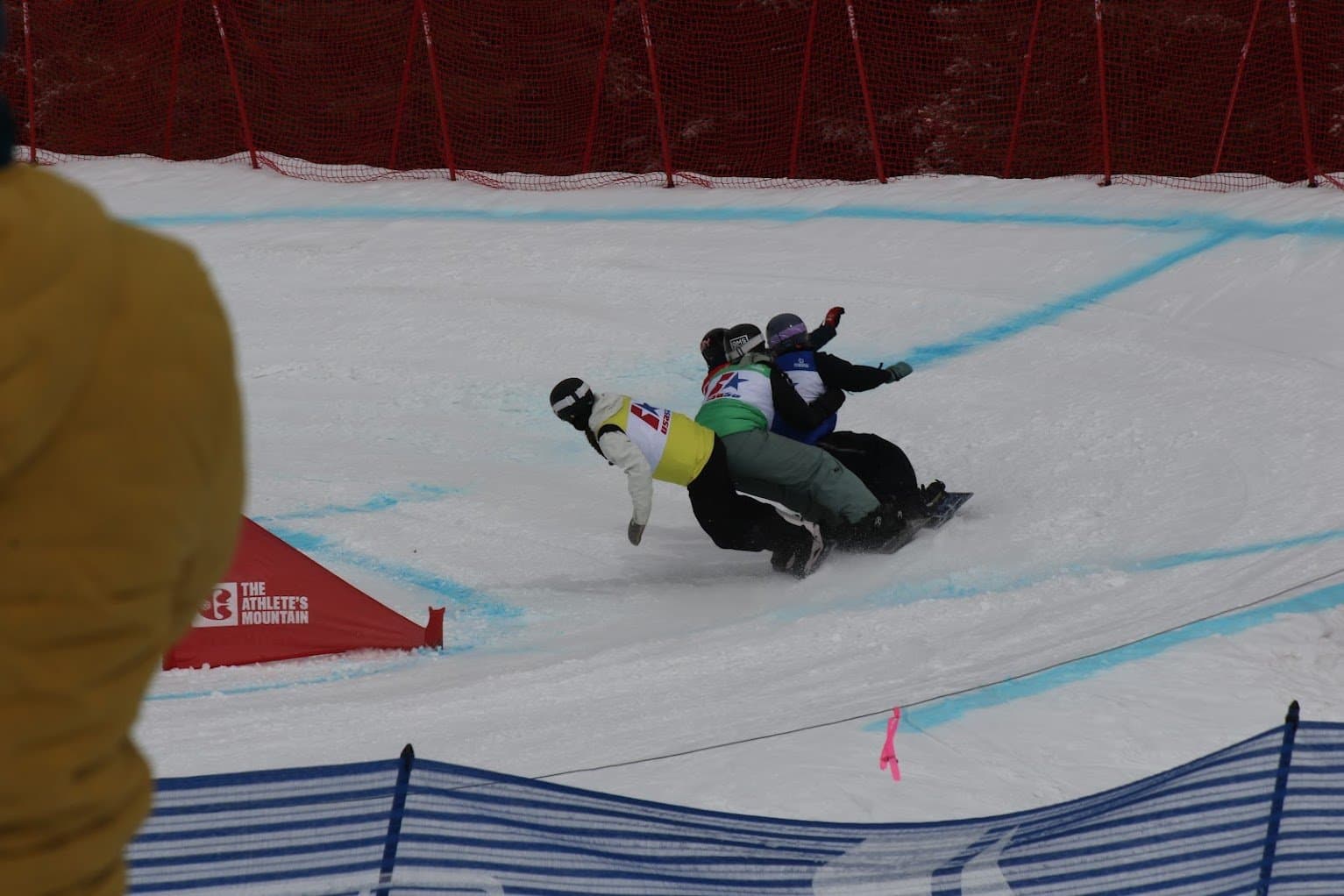
Take a 13-year-old girl coming off her first competitive SBX season. Boardercross — snowboard cross — is not recreational riding. It's a head-to-head timed discipline: banked turns, jumps, rollers, off-camber sections, all at race speed. Research on elite competitive snowboarders shows that SBX performance is best predicted by leg power, core power, starting speed, and aerobic capacity [1] — the most physically holistic discipline in competitive snowboarding.
At the recreational level, snowboard injuries concentrate in the wrist — falls onto outstretched hands. At the elite competitive level, the injury profile shifts: knee injuries account for a greater proportion of time-loss events, and wrist injuries a smaller one [2]. This reflects the higher-velocity lower extremity demands of competition riding. The forces hitting a 13-year-old's knee during a hard landing in a banked section are real forces. Her neuromuscular system is the shock absorber. The question is whether it's been trained to absorb them.
The science that follows is drawn from cutting and landing sports broadly — soccer, basketball, volleyball, handball — because that's where the ACL prevention RCT evidence lives. The mechanics transfer directly: jumping, pivoting, rapid direction change, deceleration from speed. Snowboarding, and SBX in particular, is all of these.
The Five Pillars — What the Research Says to Build
The training effect is largest precisely in the window this article is describing. Myer and colleagues' 2013 meta-analysis found a 72% reduction in ACL injury odds in pre- and early adolescent female athletes who completed structured NMT — compared with 52% in late teens, and no statistically significant reduction in early adults [5]. The younger you intervene, the larger the effect. A 2025 meta-analysis of 11 RCTs in female team-sport athletes confirmed a 50% reduction in ACL injury risk overall [6]. That is a large effect size by any standard in sports medicine.
The most effective programs shared five components. Programs incorporating at least four of them consistently outperformed single-focus protocols. Here they are, in order of evidence strength.
Pillar 1: Posterior Chain Strength
The direct mechanism: dynamic knee valgus is controlled primarily by the gluteus medius and the hip external rotators. When those muscles are weak, the hip can't resist adduction during landing — the knee collapses inward, and the ACL takes the load. Posterior chain strength is the most direct, well-supported intervention in the ACL prevention literature. Hip abductor and hamstring weakness appear as modifiable risk factors in study after study.
The exercises that address this don't need to be complicated. For a 13-year-old:
Glute Bridge
Setup: Lie on your back, knees bent, feet flat on the floor hip-width apart, arms at your sides with palms down.
The movement:
- Engage your core — draw your navel gently toward your spine.
- Press through both heels and lift your hips until your body forms a straight line from knees to shoulders.
- Squeeze the glutes hard at the top and hold for 2 seconds.
- Lower slowly — don't let the hips drop — and reset.
What right feels like: The glutes should be clearly working from the moment you drive through your heels. Your lower back should feel neutral, not arched. Core should feel engaged but not strained. This is not a back exercise; if it feels like one, something is off.
Common mistakes:
- If the lower back arches at the top: You're overextending the spine rather than driving through the glutes. Lower your hips slightly and focus the squeeze at the top.
- If the hips tilt to one side: One glute isn't firing equally. Pause, reset, and consciously press evenly through both heels.
- If it feels too easy: Slow the tempo — 3 seconds up, 2-second hold, 3 seconds down. Or progress to a single-leg variation (see below).
Breathing: Exhale as you drive the hips up. Inhale as you lower.
Progression: Single-leg glute bridge — keep one foot flat, extend the other leg straight, and repeat. The working glute now has to stabilize the full movement without help from the other side.
Other posterior chain priorities: Romanian deadlifts (bilateral first, then single-leg as technique matures), lateral band walks, and clamshells for hip external rotation.
A note on Nordic hamstring curls: The evidence for Nordic curls in hamstring injury prevention is strong in older athlete populations, and they're included in many of the most effective ACL prevention protocols. For early adolescents, they require careful introduction and qualified coaching supervision. The movement is high-load and eccentric — powerful, but only appropriate with proper progression and oversight.
Pillar 2: Landing Mechanics and Plyometrics
The biomechanical risk pattern most predictive of ACL injury isn't how hard you land — it's how you land. Stiff-knee landings, even soft ones, place far greater load on the ACL than absorbed, flexed-knee landings at higher impact. A meta-analysis of NMT interventions in youth female athletes found small but statistically significant improvements in knee flexion angle during jump-landing following training [7].
The coaching cue is specific: "soft knees, hips back." Not just "land softly." A soft landing with a straight knee is still dangerous.
Appropriate exercises: box jumps with explicit landing mechanic focus (land in an athletic quarter-squat, absorb — don't stick), broad jumps, lateral bounds with controlled landing, and drop landings (step off a low box and absorb through the hips and knees). Progression means adding a reactive demand: land and immediately change direction.
If she currently has anterior knee pain localized to the bump just below the kneecap, defer the jumping volume and focus on the strength pillars until it settles — loading a patellar tendon that's pulling on an already-inflamed tibial tubercle will extend, not shorten, recovery.
Evidence tier: strong for the principle and for NMT broadly; moderate for specific exercise selection in early adolescent snowboarders specifically.
Pillar 3: Single-Leg Stability and Balance
SBX involves sustained single-leg loading — hard banked turns, terrain absorption, reactive steering. Hip strength controls dynamic single-leg movement and reduces rotational forces at the knee during high-velocity directional changes [see Pillar 1]. But strength alone isn't sufficient. The neuromuscular system also needs to manage balance and proprioception — the ability to sense joint position and make real-time corrections — under the kind of unstable, unpredictable conditions that define competitive snowboarding.
Exercise priorities: single-leg Romanian deadlifts (one of the most sport-transferable patterns available — hip hinge on one leg, loaded), split squats (with front foot elevated for greater posterior chain engagement), Bulgarian split squats for increased range, and reactive balance work. The key distinction with balance training is reactive — not just holding still on a wobble board, but responding to perturbation while maintaining position. Single-leg broad jumps with a "stick" landing (absorb and hold, no wobble) train this quality specifically.
A note on SBX bilateral symmetry: research on elite Italian national team snowboarders found that SBX athletes — unlike alpine snowboarders — do not develop clinically significant front-to-rear leg strength asymmetry [3]. Program design for SBX athletes doesn't need heavy corrective unilateral bias; bilateral strength development and symmetrical loading is appropriate.
Pillar 4: Core and Anti-Rotation Strength
This one is specific to female athletes in a way worth pausing on. Core stability strongly predicts knee injury risk in female athletes — the predictive relationship is substantially weaker in males [4]. The mechanism is trunk displacement: when the core can't resist lateral shift during single-leg tasks, knee abduction moments rise and ACL loading increases. This is the "lateral trunk lean" pattern from the puberty section — and core training is how you train it out.
For SBX athletes specifically, the anti-rotation demand is high. Absorbing off-camber landings and riding banked sections requires a core that can resist lateral force, not just generate it. The off-season is the window to build the control that shows up automatically under the cognitive load of racing.
Exercise priorities: the Pallof press (a cable or band anti-rotation exercise with direct transfer to this pattern), dead bugs, side planks with hip abduction, half-kneeling and tall-kneeling cable chops and lifts, and single-arm loaded carries.
Evidence tier: moderate. The mechanistic case for core stability and knee injury in females is well-supported. Specific exercise prescription for SBX athletes is extrapolated from broader sports science.
Pillar 5: Ankle Mobility and Dorsiflexion
Snowboard boots are one of the most restrictive footwear environments in any sport. Reduced ankle dorsiflexion — the range of motion that allows the shin to travel forward over the foot — forces the kinetic chain to compensate upward. When the ankle can't flex, the knee absorbs more of the load than it should.
The off-season is the best window to address this, for two reasons. First, boots aren't constraining range for months. Second, stretching training produces meaningful range-of-motion gains during both childhood and adolescence — adolescents respond well to both high and low training volumes, making the off-season an effective window for targeted flexibility work [8].
Reduced dorsiflexion is also a risk factor for Osgood-Schlatter disease — a traction apophysitis of the tibial tubercle that's common in rapidly growing adolescents and can become a significant source of activity-limiting pain.
Exercise priorities: banded ankle mobilization with the knee driven forward over the toes, half-kneeling ankle stretches, weighted calf stretches on a step (performed separately for gastrocnemius and soleus to target each component), and three-dimensional ankle mobility drills as a daily warm-up ritual. These are all done in regular athletic footwear — the point is that the off-season is the window when the boots aren't constraining her range, which is precisely why the mobility gains are achievable now.
What right feels like for the half-kneeling ankle stretch: In a lunge position with the front foot flat on the floor, drive your front knee forward and out over your toes. You should feel a mild to moderate stretch in the back of your lower leg — the calf complex — and a sense of the ankle opening as the shin travels forward. Breathe steadily and ease into greater range on each exhale.
Common mistake: Letting the heel lift. If your heel comes off the floor, you've exceeded your current dorsiflexion range. Back off, keep the heel grounded, and work within your actual available range.
The Window — and Why It's the Window
Ages 12–15 represent the optimal period to intervene. Not because training after this age doesn't work — it does. But because the neuromuscular system is particularly plastic during early adolescence, and because the risk is at its peak: ACL injury rates in female athletes peak near age 16 [5]. The training window and the risk window overlap, which is why this period matters.
Chronological age is a reasonable proxy, but individual variation in pubertal timing is substantial. The window tracks with pubertal maturation, not the calendar — some 11-year-olds are already in it; some 14-year-olds aren't quite there yet. If your daughter has recently gone through a rapid height or weight growth phase, the window is likely open regardless of her age.
The other argument for the off-season is performance. The same movements that protect the knee — posterior chain strength, single-leg power, controlled landing mechanics — are the same movements that make a snowboarder faster, more explosive off the start, and more composed in the air. This isn't injury prevention versus performance development. At 13, they're the same training.
Research is clear that compliance drives results. Programs with 75% or greater session completion produced meaningfully greater injury reduction than lower-compliance comparators [6]. A 3x/week, 45-minute structured program through the summer can meaningfully shift the risk profile for a 13-year-old in her peak vulnerability window. Consistency beats complexity.
The ideal setup is a qualified strength and conditioning coach — look for a CSCS designation — with experience working with youth athletes. This matters for the Nordic hamstring progressions and the plyometric loading in particular. The program doesn't need to be expensive or elaborate. It needs to be consistent and technically sound.
Early sport specialization is also worth a note. The sports specialization literature suggests that multi-sport participation through early adolescence reduces overuse injury risk and, arguably, produces better long-term athletic development. Cross-training through the off-season — skateboarding, mountain biking, gymnastics, team sports — likely provides some of the same movement variety that a structured S&C program targets. The research on SBX-specific cross-training is absent; the general principle for youth athletes leans clearly toward diversity.
Seek evaluation from a sports medicine physician or orthopedic specialist if your daughter experiences any of the following:
- A "pop" sensation in the knee during landing, cutting, or a fall, followed by rapid swelling — this is the classic ACL injury presentation and warrants immediate evaluation
- Knee swelling that develops within 24 hours of a landing or twisting mechanism, particularly if the joint feels unstable or she's unable to bear full weight
- Anterior knee pain that worsens with activity, localized to the bump just below the kneecap (the tibial tubercle) — this may be Osgood-Schlatter disease, which is common in adolescent growth spurts and requires modified loading, not rest alone
- Persistent knee pain on the outside of the joint after landing-heavy sessions, particularly if it has a sharp or catching quality — lateral meniscus involvement warrants imaging
- Any pain during the exercises prescribed here that feels sharp, stabbing, or that radiates into the calf or shin
The Bigger Picture
The ACL gap between male and female athletes is real and large. But framing it as anatomy — as just the way things are — has left a generation of young athletes undertrained for the specific demands their bodies face at the specific moment those demands become most dangerous.
The research on neuromuscular training for ACL prevention is unusually strong for sports medicine. Fifty percent reduction in ACL injury risk is not a marginal finding. It's the kind of effect size that would end a clinical trial early. The tools exist. The evidence exists. What has mostly been missing is the awareness that the window is open, that it's finite, and that the intervention is a specific kind of training — not just "playing more sports" or "being careful."
Your daughter's knees at 13 are more trainable than they will ever be again. The summer after her season is the time to use that.
Open Sorely, tap Knees, and follow the guided strength routine built around the five pillars above.
References
-
Platzer, H. P., Raschner, C., Patterson, C., & Lembert, S. (2009). Comparison of physical characteristics and performance among elite snowboarders. Journal of Strength and Conditioning Research, 23(5), 1427–1432. https://doi.org/10.1519/JSC.0b013e3181aa1d9f
-
Torjussen, J., & Bahr, R. (2006). Injuries among elite snowboarders (FIS Snowboard World Cup). British Journal of Sports Medicine, 40(3), 230–234. https://doi.org/10.1136/bjsm.2005.021329
-
Vernillo, G., Pisoni, C., & Thiebat, G. (2016). Strength asymmetry between front and rear leg in elite snowboard athletes. Clinical Journal of Sport Medicine, 26(1), 83–85. https://doi.org/10.1097/JSM.0000000000000194
-
Zazulak, B. T., Hewett, T. E., Reeves, N. P., Goldberg, B., & Cholewicki, J. (2007). Deficits in neuromuscular control of the trunk predict knee injury risk: a prospective biomechanical-epidemiologic study. American Journal of Sports Medicine, 35(7), 1123–1130. https://doi.org/10.1177/0363546507301585
-
Myer, G. D., Sugimoto, D., Thomas, S., & Hewett, T. E. (2013). The influence of age on the effectiveness of neuromuscular training to reduce anterior cruciate ligament injury in female athletes: a meta-analysis. American Journal of Sports Medicine, 41(1), 203–215. https://doi.org/10.1177/0363546512460637
-
Gu, J., Zhang, R., Zhang, Y., & Shaharudin, S. (2025). Neuromuscular training for preventing knee injuries in female team athletes: a meta-analysis. Annals of Medicine, 57(1). https://doi.org/10.1080/07853890.2025.2581891. PMC12581765.
-
Ramachandran, A. K., Pedley, J. S., Moeskops, S., Oliver, J. L., Myer, G. D., Hsiao, H.-I., & Lloyd, R. S. (2025). Influence of neuromuscular training interventions on jump-landing biomechanics and implications for ACL injuries in youth females: a systematic review and meta-analysis. Sports Medicine, 55(5), 1265–1292. https://doi.org/10.1007/s40279-025-02190-w. PMC12106595.
-
Donti, O., Konrad, A., Panidi, I., Dinas, P. C., & Bogdanis, G. C. (2022). Is there a "window of opportunity" for flexibility development in youth? A systematic review with meta-analysis. Sports Medicine Open, 8(1), 88. https://doi.org/10.1186/s40798-022-00476-1. PMC9259532.
Ready to find your relief?
Tap your sore muscle or joint and get instant exercises — free, no signup.
Open Sorely →Medical disclaimer: The information in this article is for educational purposes only and is not a substitute for professional medical advice, diagnosis, or treatment. If you are experiencing persistent, severe, or worsening pain, please consult a licensed healthcare provider.